
Hotels vs Serviced Accommodation: Which Is Right for Your Workforce?

Ask most finance teams what a work trip costs and they will quote the room rate. Ask the person who has just spent six weeks in a hotel room 150 miles from home and you will get a very different answer.
For a one-night meeting, a hotel is hard to beat. You arrive, sleep, eat breakfast and leave. But workforce travel rarely looks like that. Contractors, engineers, project teams and relocating employees often stay for weeks or months, and the longer the stay, the more the hotel model starts to work against both the budget and the people living in it.
This guide compares hotels and serviced accommodation on the factors that actually decide whether a booking works: true cost, space, flexibility, wellbeing and practicality. It is written for the people who make these decisions, from project managers and site coordinators to HR teams and procurement leads. If you are new to the topic, start with our complete guide to contractor accommodation in the UK.
The Short Answer
Book a hotel when the stay is short, the traveller is alone and convenience matters more than space. One or two nights for a client meeting, a site visit or a training day are classic hotel trips.
Book serviced accommodation when the stay runs past a few nights, when several people are travelling together, or when the work involves long or irregular hours. That covers most construction, engineering, utility and infrastructure projects, as well as secondments, relocations and insurance stays.
The rest of this article explains why the line usually falls there, and what to check before you book either option.
The True Cost of a Stay Is Not the Room Rate
A hotel room rate looks simple, but it is only one line of a much longer bill. For anyone staying more than a few nights, the real cost includes everything the room does not provide.
Meals
Without a kitchen, every meal is bought out. Breakfast may be included, but lunch and evening meals become restaurant food, takeaways or expensive room service. Across a team and a multi-week project, subsistence quickly becomes one of the largest costs on the job. In serviced accommodation, a fully equipped kitchen lets people shop at a local supermarket and cook, which typically costs a fraction of eating out every night.
Laundry
Workwear needs washing, often several times a week. Hotel laundry services are charged per item and rarely suit hi-vis, overalls or site clothing. A washing machine in the property removes that cost entirely.
Parking
Contractors usually travel with vans, tools and equipment. City-centre hotels often charge for parking by the night, and some cannot accommodate larger vehicles at all. Many serviced properties offer free driveway or on-street parking, which matters when you are paying for several vehicles over several weeks.
Room count
Hotels price per room. A team of four usually means four rooms. A four-bedroom house or two apartments can often house the same team at a lower total cost, with shared living space thrown in.
Travel time
The cheapest option on paper is often furthest from the work. Every extra mile is fuel, time and fatigue, and an hour of commuting each way is an hour not spent working or resting.
The cheapest nightly rate and the cheapest stay are rarely the same thing. Compare the total cost of the stay, not the price of the bed.
How They Compare at a Glance
Best for: Hotel – One to three nights, solo travellers. Serviced accommodation – A week to several months, individuals or teams.
Living space: Hotel – One room for sleeping, working and relaxing. Serviced accommodation – Separate bedrooms, living and dining areas.
Kitchen: Hotel – Rarely; meals bought out. Serviced accommodation – Fully equipped kitchen in most properties.
Laundry: Hotel – Paid service, per item. Serviced accommodation – Washing machine in most properties.
Parking: Hotel – Often paid, limited for vans. Serviced accommodation – Frequently free, more space for work vehicles.
Teams: Hotel – One room per person. Serviced accommodation – Whole houses or neighbouring apartments.
Pricing: Hotel – Nightly rate. Serviced accommodation – Nightly, weekly or monthly, often lower for longer stays.
Flexibility: Hotel – Easy to cancel a night, harder to secure long blocks. Serviced accommodation – Built for extended stays and project extensions.
Space Changes How People Live and Work
A standard hotel room combines sleeping, working, eating and relaxing into roughly the same few square metres. For a night, that is fine. For a month, it becomes a problem.
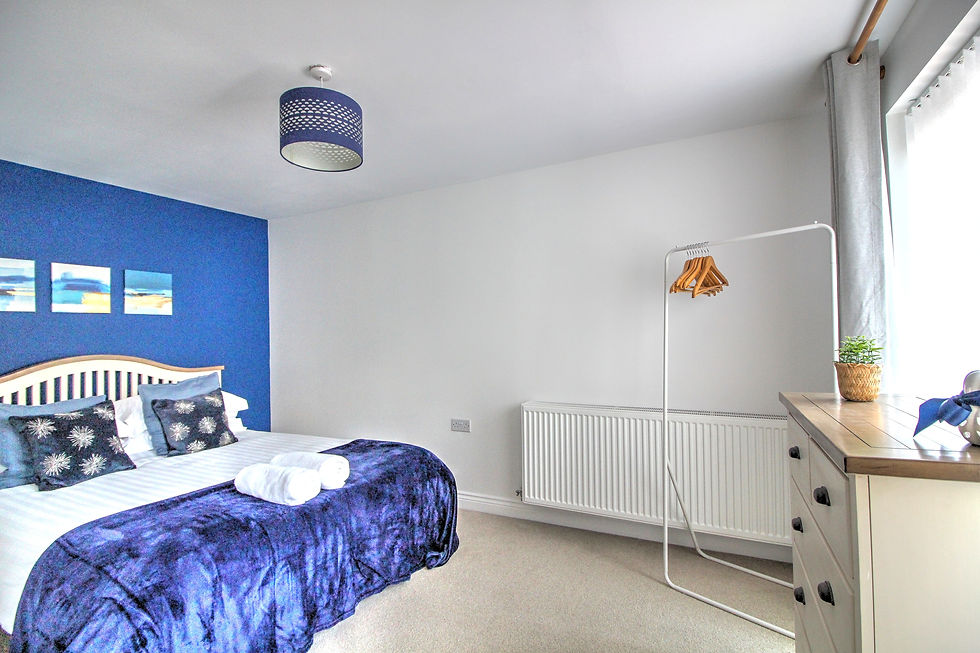
Serviced apartments and houses separate those functions. There is a bedroom for sleeping, a living room for switching off, a table for eating and, in many properties, a desk or quiet corner for paperwork and video calls. That separation is more important than it sounds. People who can step away from the bed at the end of a shift tend to rest better, and rested workers are safer and more productive on site the next morning.
For teams, the benefit multiplies. A shared house gives colleagues somewhere to plan the next day over dinner, rather than messaging each other from separate rooms along a hotel corridor.
Flexibility for Projects That Rarely Run to Plan
Few projects finish exactly on schedule. Weather, supply chains, client changes and snagging can all push dates back, and the reverse also happens when work completes early.
Hotels are built around short, transactional stays. Securing the same rooms for an unknown number of extra weeks can be difficult, particularly in busy cities or around major events. Serviced accommodation is designed for extended stays, and many providers will discuss extensions, subject to availability, as part of the original booking.
Working with an accommodation sourcing partner adds another layer of resilience. If a property cannot extend, a partner with a wide network can line up an alternative nearby, rather than leaving your project manager to start the search again from scratch.
Wellbeing Is a Business Issue
Working away from home is demanding. Long shifts, unfamiliar surroundings and time away from family all take their toll, and accommodation is one of the few factors an employer can directly control.
The small things add up: cooking a familiar meal, washing your own clothes, watching television on a sofa rather than a bed, having space to call home in private. None of them are luxuries, but together they make the difference between a stay people tolerate and one they can sustain for weeks.

Good accommodation also supports retention. Skilled contractors and engineers have choices, and a reputation for looking after people on the road is a genuine advantage when you need to staff the next project.
When a Hotel Is Still the Right Choice
Serviced accommodation is not the answer to every trip. A hotel remains the better option when:
The stay is one to three nights and the traveller is alone.
Daily cleaning, a 24-hour reception or on-site dining is essential.
The traveller needs to be in a precise city-centre location where serviced options are scarce.
The booking is so last-minute that only hotel inventory is available.
Many organisations use both: hotels for short visits, serviced accommodation for anything longer. The key is to make that choice deliberately rather than defaulting to whichever is quickest to book.
What to Check Before You Book
Whichever option you choose, a few checks prevent most of the problems we see.

Location
Measure the drive to site, not just the distance. Check access to supermarkets, pharmacies and public transport, particularly for longer stays.
Parking
If the team is travelling with vans or equipment, confirm the type of parking, whether it is free, and whether larger vehicles fit. City-centre and permit areas can differ sharply from suburban streets.
Sleeping arrangements
Ask for the bed layout, not just the bedroom count. Many professionals will share a house but not a room, so separate beds for each person is a sensible default for contractor teams.
Wi-Fi and workspace
Reports, drawings, safety documentation and video calls all need a reliable connection. Confirm Wi-Fi is included and ask whether there is somewhere suitable to work.
Safety and security
Check for working smoke alarms, secure entry and a well-maintained property, and make sure the accommodation meets your organisation's own duty-of-care requirements.
Extension terms
Ask before you book what happens if the project overruns. Knowing the answer in advance saves a scramble later.
Common Mistakes to Avoid
Leaving it late. Booking the week before a project starts limits choice, especially in busy areas or near large construction schemes.
Comparing nightly rates only. Add meals, laundry, parking, extra rooms and travel before deciding.
Booking too far from the work. A cheaper property 40 minutes further away can cost more in fuel, time and fatigue than it saves.
Ignoring the people staying there. The person who books is rarely the person who lives in the property. Ask the team what matters to them.
Frequently Asked Questions
Is serviced accommodation cheaper than a hotel?
For stays longer than a few nights, it often is once meals, laundry, parking and the number of rooms are included. Weekly and monthly rates can also bring the nightly cost down. For one or two nights, a hotel is usually simpler and comparably priced.
How long do you need to stay for serviced accommodation to make sense?
Most businesses find the benefits start after around three to five nights, and become significant on stays of two weeks or more. Some properties set minimum stays, which we take into account when sourcing.
Can serviced accommodation house a whole team together?
Yes. Larger houses and neighbouring apartments can accommodate teams of different sizes, which keeps colleagues together and often reduces the total cost compared with booking several hotel rooms.
Is cleaning included in serviced accommodation?
It varies by property. Many longer stays include a clean between guests and periodic cleans or linen changes during the stay. We confirm the arrangements for each property before you book.
Is serviced accommodation suitable for corporate travellers as well as contractors?
Yes. Secondments, training programmes, relocations and project teams all benefit from extra space, a kitchen and a workspace, particularly on stays of a week or longer.
Find the Right Stay for Your Team
There is no single right answer to hotels versus serviced accommodation, but there is a right answer for each trip. Short and simple usually means a hotel. Longer, larger or more demanding usually means serviced accommodation.
Empire Signature Stays sources serviced accommodation across the UK for contractors, corporate teams, relocating employees and insurance stays. Tell us where you need to be, when and for how many people, and we will come back with options that fit the job and the budget. You can learn more about how we work or contact our team directly.
Own a property that would suit working professionals? Partner with Empire Signature Stays and join our host network.


Comments